There is a version of this story that begins with a yoga mat, a plane ticket, and a quiet feeling that something needs to change. Maybe you know that feeling. It isn’t always dramatic — sometimes it’s just a slow, persistent sense that the life you’re living and the life you’re meant to be living are not quite the same thing. That the distance between who you are and who you could be has been growing, and that you’ve been too busy, too comfortable, or too afraid to close it.
For thousands of people every year, a Yoga Teacher Training is the moment that distance begins to close.
Not because a thirty-day program has magic powers. Not because yoga solves everything. But because YTT creates something rare and increasingly hard to find in modern life: a sustained, structured, distraction-free invitation to meet yourself honestly — and to discover that who you actually are is someone worth showing up for.
This is the story of what really happens during a Yoga Teacher Training. Not the brochure version. The human one.
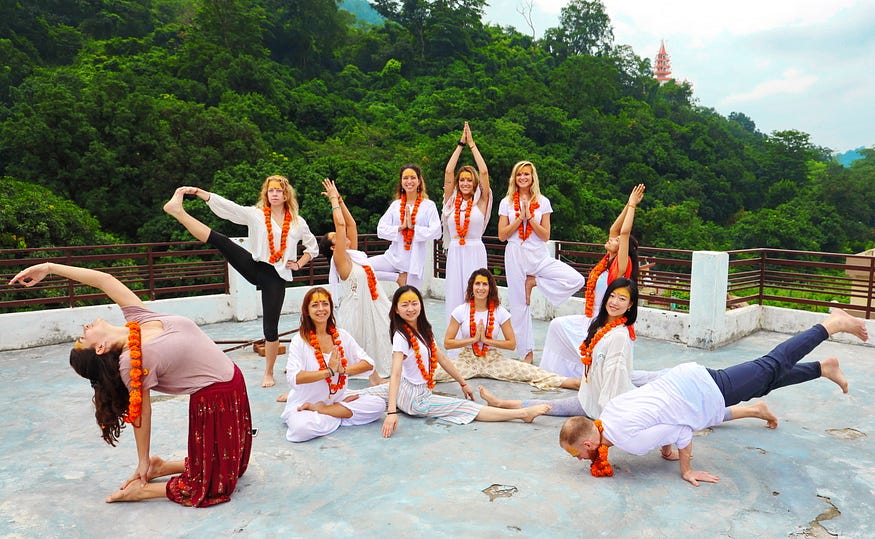
The Moment You Decide to Go
Here is something nobody tells you about Yoga Teacher Training: the transformation begins the moment you make the decision to attend — not on day one of the program.
Something shifts when you choose yourself. When you say yes to something that feels both terrifying and exactly right. The inner voice that immediately lists all the reasons you shouldn’t go — the cost, the timing, the fact that you can’t touch your toes, the sneaking suspicion that you’re not the kind of person who does things like this — that voice is not wisdom. It is fear wearing the costume of practicality.
Almost every YTT graduate has a version of the same story: they almost didn’t go. The timing was difficult. The money was a stretch. They told themselves they’d do it next year. And then something — a conversation, a moment of exhaustion, a quiet morning when the truth was louder than the excuses — pushed them across the line.
That push matters. It is the first act of a story that will keep unfolding long after the training ends.
Day One: Arriving as One Person
The first day of a Yoga Teacher Training is one of the more unusual human experiences available to modern adults. You arrive, often jet-lagged, sometimes emotional, and almost always nervous, into a room full of strangers who are equally jet-lagged, emotional, and nervous. Nobody knows anyone. Everyone is wondering, quietly, whether they belong here.
By the end of the first week, those same strangers will feel like people you’ve known for years.
But on day one, there is just the newness of it all — the unfamiliar schedule, the predawn alarm, the room that is not your room, the food that is not your food, the silence where your usual distractions used to be. And underneath the newness, something else: a feeling that something is beginning. That this is not a holiday or a detox or a fancy retreat. This is something that will require something of you.
That requirement is the point. And most people feel it immediately, even if they can’t name it yet.
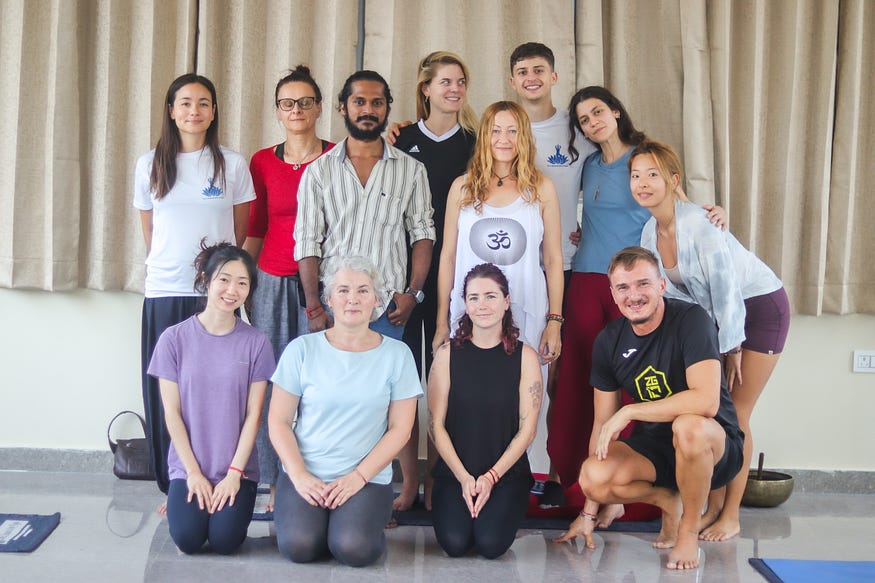
Your Body Becomes a Home, Not a Machine
Most of us arrive at yoga — and at our bodies — with a performance mindset. The body is something to be managed, trained, pushed, and occasionally punished. We measure it against standards it was never designed to meet. We override its signals when they’re inconvenient. We treat discomfort as weakness and rest as laziness.
Yoga Teacher Training begins the slow, gentle, and sometimes confronting process of unlearning all of that.
Through daily asana practice — sometimes twice a day — combined with anatomy study that is practical rather than academic, you begin to develop a genuinely different relationship with your physical self. You learn where you hold tension without knowing it. You discover which parts of your body you have been ignoring, and which parts you have been pushing beyond their honest limits. You start to understand the difference between the discomfort of growth and the pain of harm — and you learn to respect that difference rather than bulldoze through it.
What emerges, gradually and without fanfare, is something that looks like body confidence but feels deeper than that. It is not confidence in how your body appears. It is confidence in how your body communicates — and trust that you are finally, genuinely listening. For many people, this is the first time in their adult lives that they have inhabited their own skin with anything resembling peace.
That peace does not leave when the training ends. It travels home with you, woven into the way you move, rest, and treat yourself on ordinary days.
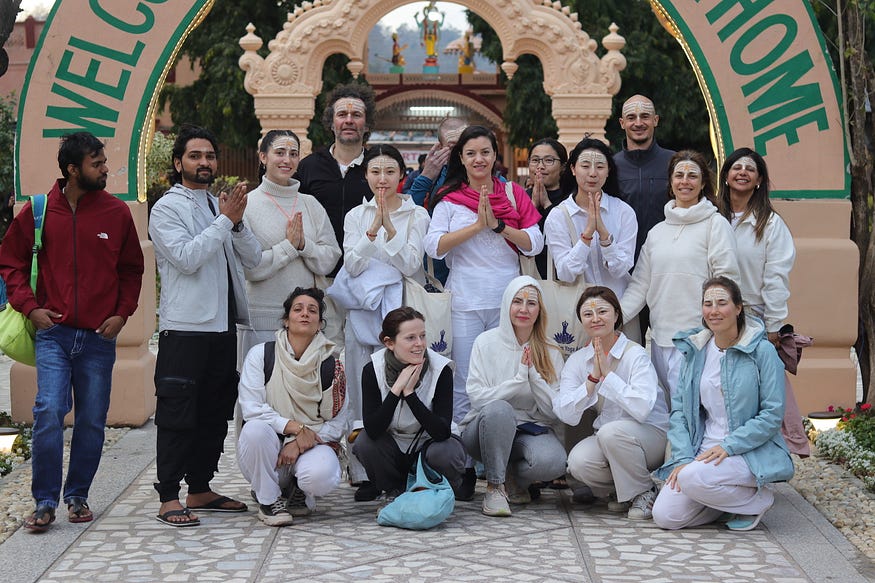
Breath Becomes Your Most Powerful Tool
You have been breathing your entire life. Every moment of every day, without thinking about it, your body has been keeping you alive through this one automatic, continuous act.
And if you are like most people, you have been doing it at a fraction of your actual capacity.
Shallow, chest-bound breathing — the default mode of anxious, busy, modern humans — keeps the nervous system in a state of low-grade alertness. Not full panic, but not genuine rest either. A kind of permanent low hum of tension that becomes so familiar we mistake it for normal.
Pranayama, the formal practice of conscious breath control taught in every serious YTT, changes this at a physiological level. Techniques like Nadi Shodhana alternate nostril breathing, Kapalabhati, Ujjayi, and Bhramari are not abstract spiritual rituals. They are precise, evidence-backed tools that regulate the nervous system, shift the body between states of activation and recovery, lower cortisol, sharpen mental focus, and process emotional states that have been sitting, undigested, in the body for months or years.
The first time many students complete a full pranayama session — really complete it, with full attention and a genuinely open breath — they feel something they struggle to describe. A kind of cleanliness. A spaciousness in the chest and mind that they haven’t experienced since childhood. Some people cry, without knowing exactly why. The body, it turns out, has been waiting a long time for permission to fully exhale.
This is the skill that YTT graduates consistently name as the most practically useful thing they carry into daily life. Not a sequence of poses. Not Sanskrit terminology. The breath. Simple, free, always available, and endlessly powerful.
The Mind Begins to Settle
The mind that arrives at a YTT on day one is not the mind that leaves thirty days later. This is one of the most consistent things graduates report, and one of the hardest to explain to someone who hasn’t experienced it.
We live in an era of extraordinary mental noise. The relentless scroll of information, opinion, notification, and demand has created a baseline level of mental agitation that most of us no longer even notice — the way you stop hearing traffic after living near a motorway long enough. This noise does not feel like suffering. It just feels like life.
Until you spend thirty days doing something different.
Meditation in YTT is not a one-off session or a guided relaxation at the end of a stressful week. It is a daily practice, built incrementally over weeks, that begins to reorganize your relationship with your own mind. At first, sitting still feels impossible. The thoughts come fast and relentlessly. The mind generates grocery lists, old arguments, future anxieties, and creative plans with extraordinary energy and very little direction.
But slowly — and it is slow, which is part of the teaching — something begins to change. Gaps appear between thoughts. A quality of quiet that most adults have not experienced since childhood starts to become accessible. And in that quiet, something shifts: you stop being entirely at the mercy of your own mind. You develop what the ancient yogic texts call the quality of the witness — the part of you that can observe thoughts and feelings without being consumed by them.
This is not a small thing. It is, for many people, the most significant inner change of their adult lives. And unlike a yoga pose, it does not require flexibility, strength, or youth. It requires only the willingness to sit, breathe, and return — again and again — to the present moment.
Yoga Philosophy Lands Differently When You’re Living It
Ask any YTT graduate which part of the training surprised them most, and a remarkable number will say the philosophy.
They came for the poses. They stayed for the Sutras.
Yoga philosophy — the ancient framework of ethical living, mental training, and inner freedom laid out in texts like Patanjali’s Yoga Sutras and the Bhagavad Gita — sounds, on paper, like something distant and academic. Terms like ahimsa, satya, aparigraha, and santosha seem like interesting ideas belonging to a different time and culture.
And then you spend three weeks in an immersive program, stripped of distraction, practicing daily introspection, and living alongside thirty people who are doing the same — and suddenly these concepts are not distant at all. Ahimsa, non-harm, becomes painfully personal when you realize how violently you have been speaking to yourself for years. Satya, truthfulness, confronts you with the stories you have been telling yourself about why you can’t change, why you’re not ready, why your life is the way it is. Aparigraha, non-attachment, quietly dismantles the grip you’ve been keeping on outcomes, relationships, and identities that have been holding you back.
These are not abstract philosophical insights. They are precise, practical tools for living — and they work most powerfully when you encounter them in conditions where you cannot look away.
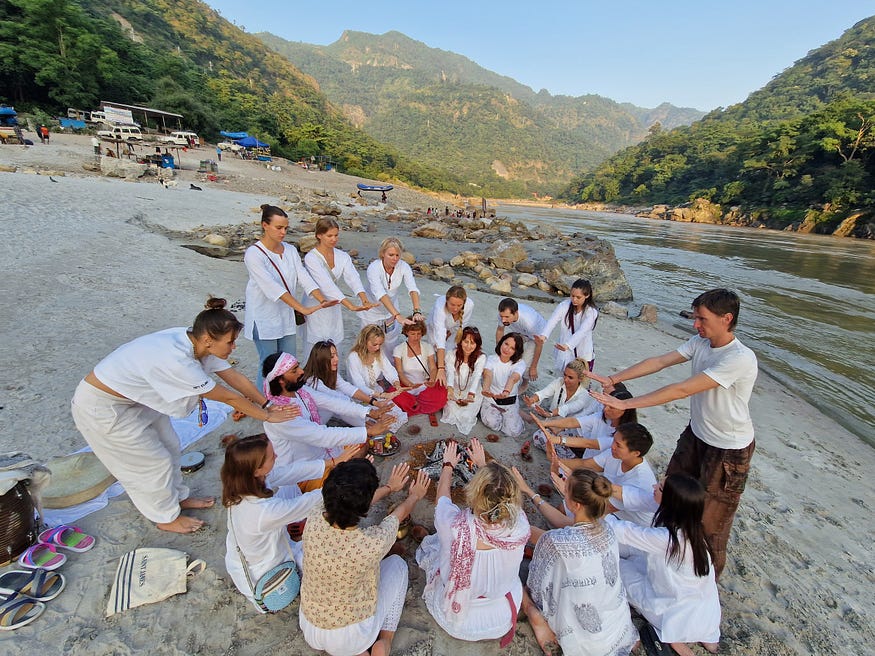
.You Build Discipline You Actually Want to Keep
The daily schedule of a residential YTT is demanding. Up before the sun. Morning meditation and pranayama before breakfast. Asana practice. Anatomy class. Philosophy lecture. Teaching methodology. Another asana session in the late afternoon. Evening kirtan or self-study. In bed before ten.
For the first few days, this structure feels relentless. And then it becomes something completely different: it begins to feel like devotion.
There is a profound difference between discipline that is imposed and discipline that is chosen — between the rigidity of obligation and the steadiness of commitment. YTT teaches you the second kind. You wake early, not because you must but because the morning practice has become something you genuinely want — something that sets the tone for everything else.
By the final week of a thirty-day training, students have done something remarkable: they have shown up for themselves, consistently, every single day, even when they were tired, even when a pose frustrated them, even when a concept didn’t click, even when being vulnerable in a room full of people felt genuinely terrifying. That track record — experienced in the body, not just recalled by the mind — becomes a new kind of self-trust. A confidence that does not depend on external validation because it was built through daily, private acts of showing up.
When life outside the training gets difficult — and it always does — graduates carry this with them. They’ve already proved to themselves that they can do hard things. They have the evidence.
Relationships Transform — Starting With Yourself
Something quietly extraordinary happens when thirty people from different countries, careers, and life stories spend thirty days practicing vulnerability together. They become genuinely close in a way that is rare in adult life — the kind of closeness that usually takes years to build and sometimes never arrives at all.
The communication skills developed during YTT are equally significant. Learning to cue a yoga pose with clarity, warmth, and precision is a masterclass in conscious communication — you must be specific without being robotic, encouraging without being patronizing, present without being intrusive. Students practice this first in teaching labs, and then find, almost without noticing, that they are doing it everywhere else: in conversations with partners, in difficult exchanges with colleagues, in the patient quiet they offer a friend who is struggling.
But the most important relationship that changes during YTT is the one you have with yourself.
Daily self-observation — watching your reactions, your resistances, your patterns with honesty but without judgment — builds something that most people have spent years searching for elsewhere: genuine self-compassion. Not the soft, avoidant kind that tells you everything is fine when it isn’t. The clear-eyed, kind kind that sees you accurately — limitations, contradictions, beauty, and all — and chooses to stay present with you anyway.
From that foundation, everything else becomes possible.
You Come Home — But Home Has Changed
Re-entry after a YTT is one of the experiences graduates talk about most honestly — and most rarely.
The first few days back in regular life can feel disorienting. The world is exactly as you left it. Your home is the same. Your responsibilities are waiting. But you are not quite the same person who left — and that mismatch can feel tender, even a little lonely.
This is normal. And it passes.
What doesn’t pass is the quality of presence that YTT instills. The ability to pause before reacting. The access to breath as a tool. The habit of asking what is actually true rather than what is simply familiar. The willingness to choose discomfort when it leads somewhere worth going.
Some graduates go on to teach yoga. Many don’t. Some change careers. Some mend relationships. Some finally start the creative project they’ve been postponing for years. Some simply become better, more present, more honest versions of themselves in every ordinary moment.
All of these are the same transformation, expressed differently.
The Ripple That Never Fully Stops
Here is the thing about changing yourself that most people don’t fully understand until after it happens: you cannot change yourself in isolation. Your transformation ripples outward, touching everyone around you — whether you intend it to or not.
The partner who notices you listening differently. The friend who says, unprompted, that you seem lighter. The colleague who finds you easier to work with, not because you’ve become agreeable, but because you’ve become genuine. The child who grows up watching a parent who takes their own inner life seriously — and learns, without being told, that they are allowed to do the same.
This is the real depth of what a Yoga Teacher Training offers. Not just a certificate that qualifies you to teach in a studio. But the beginning of a way of living that radiates outward in ways you cannot fully trace or predict — touching lives you may never even know you’ve touched.
One decision. Thirty days. A ripple that doesn’t stop.
The Invitation
If you have read this far, something in you is already saying yes. Perhaps quietly. Perhaps underneath a layer of practical objections and reasonable fears. 200 hour yoga course in India .
The timing will never be perfect. There will always be a reason to wait. And the version of you who is tired of waiting — who is ready, even if imperfectly, even without knowing exactly what comes next — that version deserves to be heard.
Yoga Teacher Training will meet you exactly where you are. It will ask more of you than you expect. It will give you more than you can imagine right now. And it will return you to your life as someone who knows, not just intellectually but in the marrow of their bones, that they are capable of living more fully, more honestly, and more beautifully than they thought.
That knowledge, once gained, cannot be taken from you.